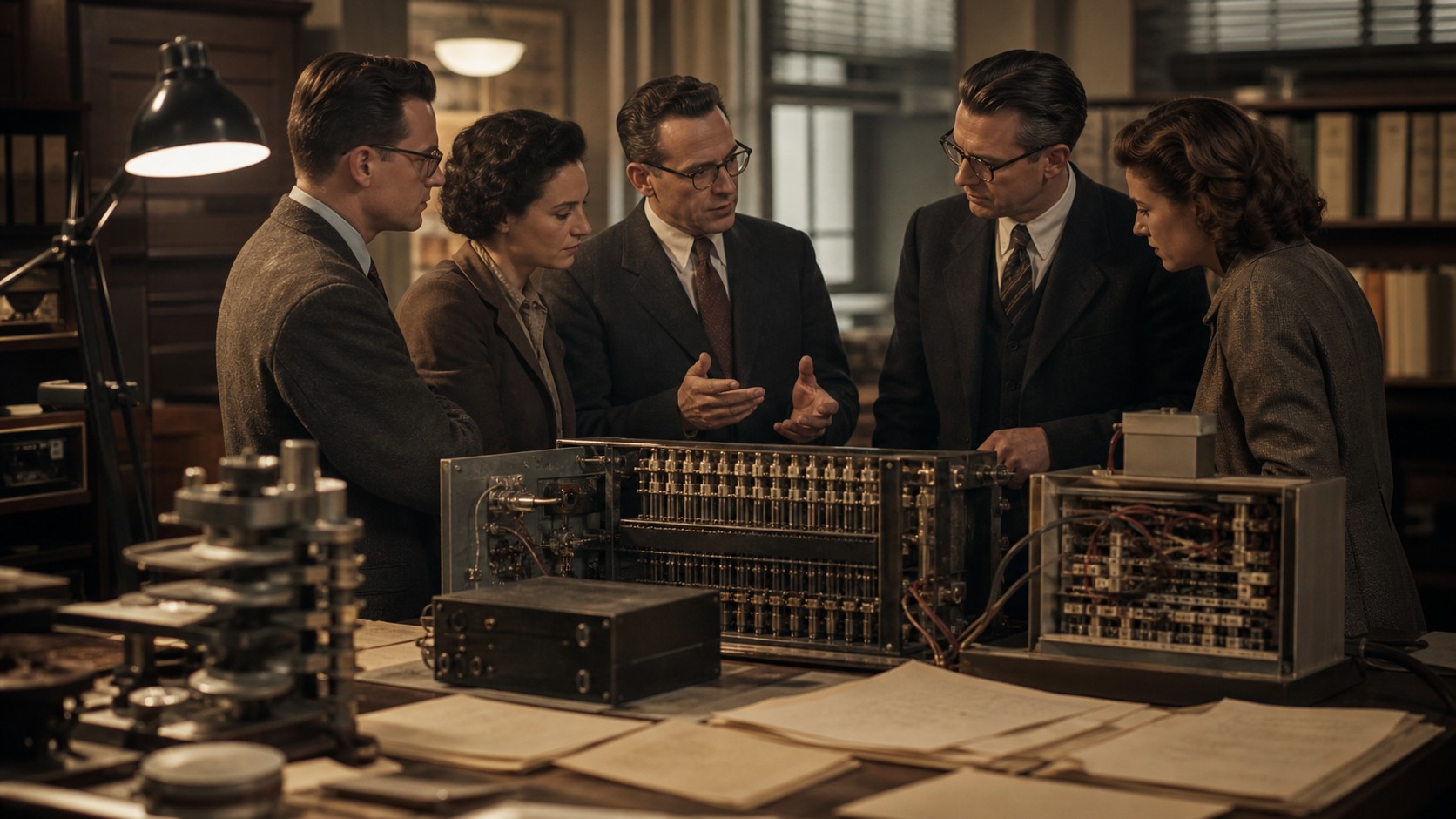
AI Was Founded by a Community, Not a Single Inventor
Artificial intelligence does not have one inventor in the simple way a device or product sometimes does. It emerged from a cluster of ideas in mathematics, philosophy, computer science, psychology, neuroscience, and engineering. Several people gave the field its language, its early goals, and its first demonstrations. The phrase artificial intelligence became attached to a formal research agenda in the 1950s, but the intellectual roots are older. If you ask who invented AI, the most accurate answer is that AI was founded by a community of researchers who believed machines might be built to perform tasks associated with human intelligence.
A: No single person invented it; AI emerged from a community of researchers and earlier intellectual traditions.
A: John McCarthy is widely associated with coining and promoting the term.
A: Turing did not found the field alone, but his ideas deeply shaped the question of machine intelligence.
A: The 1956 workshop helped organize AI as a named research field.
A: Some learning ideas existed, but much early AI focused on symbols and rules.
A: Simple stories are memorable, but AI's development was too broad for one name.
A: No. Search, planning, rules, and representation still influence modern systems.
A: It became practical in waves, especially as data, hardware, and machine learning improved.
A: No. It popularized a recent chapter built on decades of research.
A: AI is a layered field, not a single invention or one-person achievement.
Why the Question Is Tricky
The question sounds simple because many inventions have a single familiar name attached to them. AI is different. It is not one machine, one algorithm, or one patent. It is a research field made of many methods, from symbolic reasoning and search to machine learning and neural networks. Each method has its own origin story.
A better way to ask the question is to separate three things: who imagined machine intelligence, who made it mathematically plausible, and who organized it as a named field. Different people belong in each answer. That layered history makes AI richer than a single-inventor story.
That is why the fairest answer uses several names and several milestones. A person can be central without being solitary, and a workshop can be foundational without being the whole invention.
The Older Dream of Mechanical Reasoning
Long before digital computers, philosophers and mathematicians explored whether reasoning could be formalized. Logic showed that parts of thought could be represented with symbols and rules. Calculating machines showed that mechanical devices could perform operations once associated with human clerks. These were not AI systems, but they made the dream thinkable.
This matters because AI began as an argument about representation. If a problem can be described clearly enough, perhaps a machine can manipulate that description. Early AI inherited this faith in symbols, rules, and procedures. The field's later history would challenge that faith, but it did not begin from nowhere.
The old dream also carried a philosophical edge. Machines forced people to ask what intelligence really means. Is intelligence reasoning, learning, language, adaptation, perception, or all of these together? AI's origins are tangled because the concept of intelligence itself is tangled.
This older background also explains why AI has always attracted both engineers and philosophers. The field builds systems, but it also forces people to define reasoning, language, evidence, and learning more carefully.
Alan Turing and the Machine Intelligence Question
Alan Turing did not invent artificial intelligence as a field, but he made one of its most important questions unavoidable. He helped define the theory of computation and later asked whether machines could imitate intelligent conversation. His famous imitation game reframed the debate away from abstract definitions and toward observable behavior.
Turing's contribution was not a finished AI system. It was a way of thinking. He showed that programmable machines were not merely calculators with fixed purposes. They could, in principle, carry out any procedure that could be formalized. That idea became one of the foundations beneath later AI research.
Turing also matters because he resisted mystical definitions. Rather than asking whether a machine had a mind in an unreachable inner sense, he asked how a machine's behavior might be judged. That move still influences AI evaluation today. We often cannot inspect every internal reason a system behaves as it does, so we design tests, tasks, comparisons, and conversations that reveal capability from the outside.
His work also sits between theory and culture. The idea that a machine could participate in language unsettled older assumptions about intelligence, but it also gave engineers a target. If machines could process symbols, follow procedures, and adapt outputs to context, then machine intelligence could become a practical research question rather than only a philosophical puzzle.
Turing's influence is especially visible whenever people evaluate AI through tasks. Modern benchmarks, chatbot tests, and model comparisons all echo the idea that machine intelligence should be examined through performance, not slogans.
The Dartmouth Moment
The field of artificial intelligence is usually traced to a 1956 summer research workshop at Dartmouth College. John McCarthy, Marvin Minsky, Claude Shannon, Nathaniel Rochester, and others helped shape the proposal and conversation. The workshop did not produce modern AI overnight, but it gave the field a name and a shared ambition.
John McCarthy is often associated with coining the term artificial intelligence. That does not mean he invented every idea inside the field. It means he helped name and organize a research program around the possibility that aspects of intelligence could be described precisely enough for machines to simulate.
The Dartmouth workshop matters because naming a field changes what researchers can do. It creates a banner for funding, debate, collaboration, and disagreement. Once AI had a name, people could build programs, conferences, laboratories, and expectations around it.
The workshop's participants did not agree on everything, which is part of its importance. A field becomes real when people can argue inside it, propose methods, and test rival approaches under a shared question.
Early Programs and Early Optimism
Early AI researchers built programs that played games, proved theorems, solved symbolic problems, and manipulated language in constrained ways. These systems were impressive because computers were new and limited. A machine that could search possible moves or follow logical rules seemed to suggest that more general intelligence might arrive quickly.
That optimism was sincere, but it underestimated the difficulty of common sense and perception. A game board has clear rules. The real world has ambiguity, missing information, exceptions, and context. AI's early successes were real, yet they made the remaining problems look easier than they were.
This pattern repeated throughout AI history. A breakthrough in a controlled setting generated excitement, then messy reality forced a more careful understanding. The origins of AI include both ambition and repeated correction.
Those early programs also depended on the limits of their worlds. A theorem prover operates inside formal rules. A game-playing program operates inside a board with legal moves. These settings are useful because they make intelligence measurable, but they leave out much of ordinary life. The later challenge was bringing AI from clean symbolic spaces into noisy human environments.
Early optimism was not foolish; it was incomplete. Researchers had found islands of machine competence and had not yet mapped the ocean between those islands and everyday intelligence.
Symbolic AI's Founding Role
The earliest mainstream approach is often called symbolic AI. It treated intelligence as the manipulation of symbols according to rules. A system might represent facts, goals, and relationships, then search for a solution. This approach fit the intellectual environment of early computing, where logic and formal procedure were central.
Symbolic AI produced valuable ideas that still matter: knowledge representation, planning, search, inference, and expert reasoning. Even when modern systems rely heavily on learned patterns, they often sit inside workflows that use rules, constraints, retrieval, or structured tools. The early symbolic tradition remains part of the field's inheritance.
Symbolic AI's influence can be seen whenever a system needs explicit structure. A scheduling tool, planning agent, or rule-governed workflow may still use constraints that look more like early AI than modern deep learning. The field did not travel from wrong ideas to right ideas in a straight line. It learned which ideas fit which problems.
Many modern systems still use symbolic pieces for reliability. A language model may generate text, while a rule checks policy, a search system retrieves sources, and a workflow decides what action is allowed.
Machine Learning Changes the Origin Story
The invention of AI cannot be separated from the later rise of machine learning. Instead of programming rules for every situation, researchers developed systems that improved from examples. This shifted the field from hand-coded intelligence toward learned behavior. It also changed which pioneers became central to the story.
Neural network researchers, statisticians, information theorists, and data scientists all helped expand what AI could become. The modern public often meets AI through machine learning systems, not symbolic theorem provers. That means the origin story has several chapters, each with its own builders.
Machine learning also changed the kind of evidence researchers valued. Instead of showing that a program followed clever rules, teams could measure performance on examples. That made progress more empirical, but it also introduced new responsibilities. Datasets could be incomplete, labels could be wrong, and benchmark success could hide real-world weakness.
This shift expanded AI beyond a small circle of symbolic reasoning specialists. It pulled in people who understood statistics, optimization, databases, hardware, and large-scale software systems. Modern AI's origin story therefore includes not only famous theorists but also the builders of infrastructure that made learning from data possible.
Machine learning also made AI more dependent on measurement. Once examples drive improvement, the choice of examples and the definition of success become part of the invention itself.
No One Owns the Invention
It is tempting to crown one person as the inventor because simple stories are easier to remember. But AI is closer to a city than a gadget. Many people planned roads, built foundations, argued over design, abandoned sections, and returned with better tools. The result is a field rather than a single object.
This does not diminish the pioneers. It makes their contributions more precise. Turing sharpened the question. McCarthy helped name the field. Minsky, Newell, Simon, Shannon, Rochester, and many others built early programs and institutions. Later researchers made learning systems practical at scale. Each contribution belongs to the larger origin.
A collective origin story also makes room for international and interdisciplinary contributions that simplified histories often miss. AI grew through laboratories, universities, government projects, private companies, and open research communities. Some contributors wrote theory. Others built languages, chips, datasets, tools, and teaching materials. The field advanced because those pieces eventually connected.
The collective view also honors the people who made AI usable outside laboratories. Interfaces, documentation, datasets, and education all shaped how the field moved from theory to practice.
Why This History Matters Now
Understanding AI's origins helps beginners resist both hype and myth. Modern AI did not appear suddenly from one company or one chatbot. It grew through decades of theory, hardware, data, software, and experimentation. Seeing that lineage makes today's tools less mysterious.
It also makes responsibility clearer. If AI is a field built by many people, its future will also be shaped by many people: researchers, users, educators, lawmakers, designers, and communities affected by automated systems. The origin story is not finished. It is still being written.
The origin question is still useful, though, because it teaches careful attribution. When a modern product claims to represent the future of AI, it is standing on a long chain of public research and shared ideas. Remembering that chain helps beginners see beyond marketing and appreciate the accumulated work behind today's systems.
For beginners, this history provides a calm starting point. AI is neither a miracle born yesterday nor a finished destiny. It is an evolving field built through arguments, prototypes, failures, and renewed attempts.
The practical answer, then, is both specific and plural. McCarthy helped name the field, Turing helped frame the possibility, and many others built the early methods. AI's invention is best understood as a founding conversation that became a discipline.