
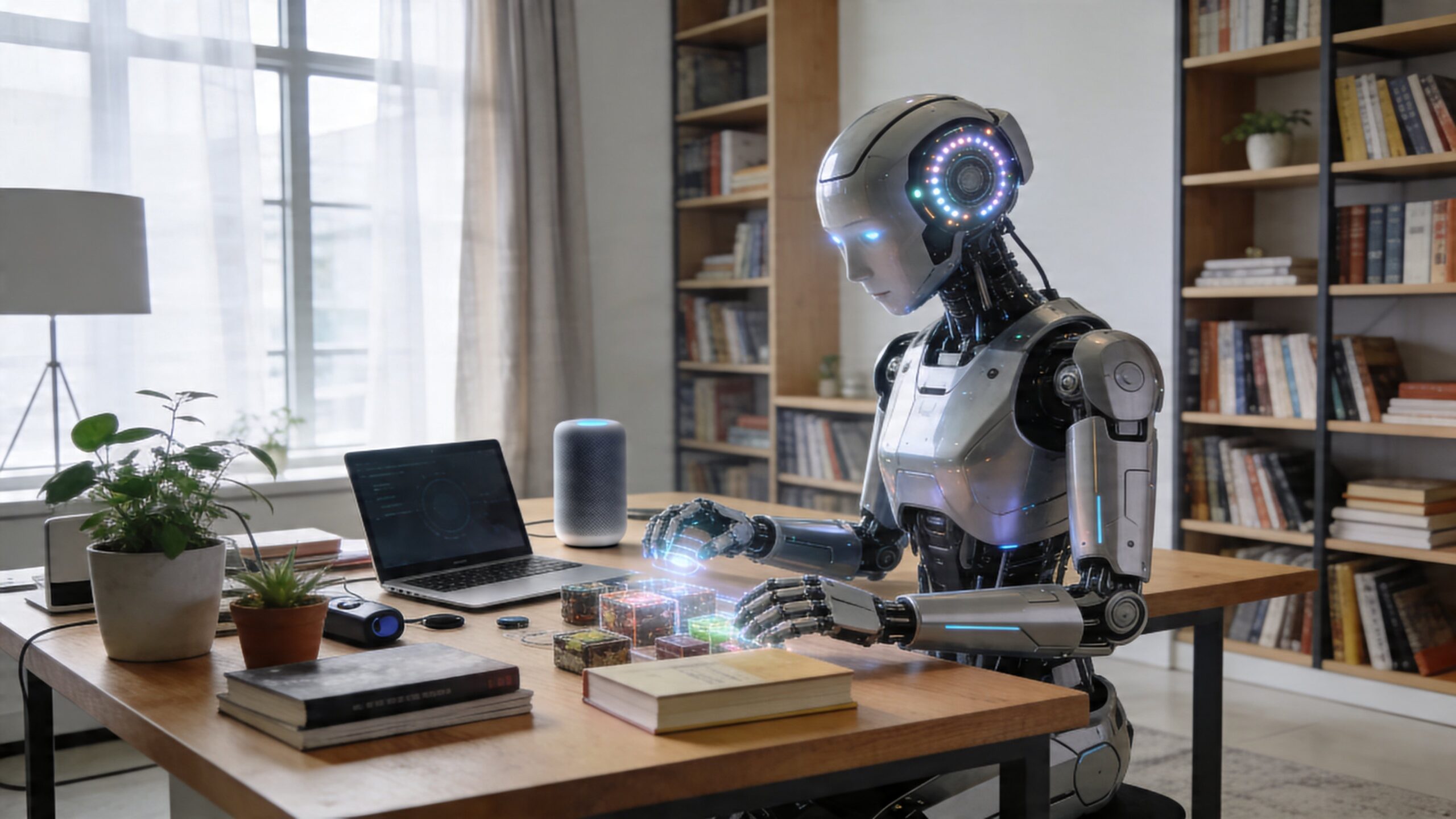
A New Kind of Sight in the Digital Age
Computer vision is one of the most fascinating branches of artificial intelligence because it focuses on something humans do almost effortlessly every waking moment: seeing. We look at a face and recognize a friend. We glance at a street and immediately understand where the sidewalk ends and the traffic begins. We spot a coffee mug on a desk, notice whether the sky looks stormy, and read emotion in a smile without consciously thinking through each step. Computer vision is the effort to teach machines to do something similar. It gives software the ability to interpret images, analyze video, recognize patterns, and respond to the visual world in ways that can be useful, fast, and sometimes astonishingly accurate. At its core, computer vision is about turning pixels into meaning. A camera captures a scene as raw visual data, but raw data alone is not understanding. For a machine, an image is not naturally a dog, a stop sign, a cracked windshield, or a handwritten note. It is a grid of numbers representing color, brightness, and position. Computer vision bridges the gap between those numbers and real-world understanding. It allows an AI system to identify objects, detect motion, estimate distances, segment scenes, read text, inspect defects, and even make predictions about what is likely happening in a visual environment. That ability has transformed industries ranging from healthcare and manufacturing to retail, transportation, agriculture, security, entertainment, and consumer technology.
A: It is a field of AI that helps machines interpret images and video.
A: Not exactly; image recognition is one task within the broader field of computer vision.
A: It learns from labeled visual data and improves by finding patterns during training.
A: Yes, many systems analyze live camera feeds for fast decisions and alerts.
A: It appears in phones, cars, healthcare, factories, retail, agriculture, and robotics.
A: No, it detects patterns effectively but still lacks full human-style context and common sense.
A: Because the model’s accuracy depends heavily on the clarity, diversity, and labels of its training images.
A: Yes, OCR systems can detect and extract text from signs, documents, and photos.
A: No, performance can drop with poor lighting, bias, unusual angles, or unfamiliar scenes.
A: It helps AI connect with the visual world and makes many modern systems smarter and more useful.
How Images Become Data Machines Can Understand
To understand computer vision, it helps to begin with the image itself. Every digital image is made of pixels, and every pixel contains information. In a color image, each pixel usually stores values for red, green, and blue. Multiply that across thousands or millions of pixels, and you get a massive field of numerical information. To a machine, that image is not immediately meaningful. The challenge is to extract structure from the chaos. Where does one object end and another begin? Which shapes matter? Which colors are relevant? What patterns repeat? What changes from frame to frame in a video feed? Earlier computer vision systems relied heavily on hand-crafted rules. Engineers would design filters and formulas to detect edges, corners, textures, or shapes. Those systems could be useful, especially in controlled environments, but they often struggled when conditions changed. A slightly darker room, a different camera angle, a shadow across the object, or a noisy background could reduce accuracy dramatically. The world is messy, and visual understanding is rarely as simple as matching a fixed rule. Modern AI changed that by allowing systems to learn from examples instead of depending only on rigid instructions. Instead of telling a model exactly how a cat or pedestrian should look in every condition, developers can train it on thousands or millions of labeled images. The system gradually learns which features matter. It begins to recognize patterns across different lighting, angles, sizes, and backgrounds. This learning-based approach made computer vision far more flexible and far more powerful.
Why Machine Learning Changed Everything
The real leap in computer vision came when machine learning, and especially deep learning, entered the picture. Rather than asking engineers to define every meaningful visual feature by hand, deep learning models learn features automatically from data. This matters because visual complexity is enormous. A human face can appear in countless expressions, poses, ages, and lighting situations, yet we still recognize it as a face. Deep learning made it possible for machines to develop a layered understanding of images that approaches this kind of flexibility.
Convolutional neural networks, often called CNNs, became especially important in this evolution. These networks are designed to process images by scanning local patterns and building them into larger concepts. Early layers might detect edges or color gradients. Later layers might identify shapes, textures, or repeated structures. Deeper layers can begin to distinguish between higher-level objects, such as a bicycle, a tree, or a building. This layered learning process mirrors, in a loose sense, the way complex perception is built from simpler signals. The result is that modern computer vision systems can achieve remarkable performance on tasks that once seemed almost impossible. They can classify images, detect multiple objects in real time, identify abnormalities in medical scans, analyze sports footage, track inventory on store shelves, and help autonomous systems interpret their surroundings. The breakthrough was not just that computers could see more clearly, but that they could learn how to see from experience.
The Core Tasks of Computer Vision
Computer vision is not one single ability. It is a family of related tasks that help machines understand visual information in different ways. One of the most basic is image classification, where a system looks at an image and decides what it contains. For example, it may determine whether a photo shows a dog, a car, or a piece of fruit. This sounds simple, but classification is a major building block because it teaches systems to connect visual patterns to labels. Another important task is object detection. Instead of saying only that an image contains a dog, object detection identifies where the dog is in the image. It often draws a bounding box around the object and may detect multiple objects at once. That makes it useful for applications like surveillance, self-driving systems, robotics, and manufacturing inspection, where location matters as much as identity.
Then there is image segmentation, which goes even further. Segmentation assigns meaning to individual pixels or regions, effectively outlining objects with greater precision than a simple box. This is especially valuable in areas like medical imaging, where exact boundaries matter, or in autonomous navigation, where a system needs to distinguish roads, sidewalks, people, vehicles, and obstacles with fine detail. Computer vision can also include facial recognition, pose estimation, optical character recognition, anomaly detection, motion tracking, depth estimation, and scene understanding. Each task expands the machine’s visual intelligence. Together, they form a toolbox that allows AI to interpret the world through cameras and image data.
How AI Learns to Recognize the World
Training a computer vision model begins with data. A model learns best when it is exposed to large volumes of relevant images or video examples. In many cases, these images are labeled by humans. A label might identify the object in a picture, mark its location, outline its edges, or describe what is happening in the scene. The more diverse and accurate the training data, the better the model’s chance of performing well in real conditions. This process sounds straightforward, but it is one of the hardest parts of computer vision. Real-world data is expensive to gather, slow to label, and full of imperfections. Images may be blurry, poorly lit, partially blocked, or captured from unusual angles. Different cameras can produce different visual characteristics. People, objects, and environments change constantly. A model trained only on polished, ideal images may perform poorly when deployed in the wild. That is why good computer vision depends not only on model design but also on careful dataset creation. Teams must think about representation, balance, edge cases, and bias. If a model sees only sunny streets during training, it may struggle in snow or fog. If it is trained mostly on one type of face, product packaging, or handwriting style, its accuracy may drop for others. Teaching AI to see well means exposing it to the diversity of the real world, not just the easiest examples.
Everyday Places You Already Encounter Computer Vision
Many people interact with computer vision every day without realizing it. When a smartphone unlocks by recognizing a face, computer vision is at work. When a camera app automatically focuses on people, blurs a background, or groups photos by subject, that is computer vision. When a translation app reads text from a sign through the camera, the system is combining vision with language processing. Even video call software that tracks your face or adjusts framing uses visual intelligence.
In cars, computer vision helps monitor lanes, detect nearby vehicles, recognize traffic signs, and alert drivers to hazards. In retail, it can help manage inventory, reduce checkout friction, and analyze shelf conditions. In healthcare, it assists with medical scans, pathology slides, and diagnostic image review. In factories, it is used for quality inspection, detecting tiny defects faster and more consistently than manual checks in some situations. In agriculture, cameras can monitor plant health, identify weeds, and help optimize harvest decisions. This wide adoption shows why computer vision matters so much. It is not a niche laboratory experiment. It is becoming part of how machines interact with the physical world. The more cameras and sensors are integrated into daily systems, the more important visual AI becomes.
Computer Vision in Healthcare, Industry, and Science
Some of the most exciting uses of computer vision appear in fields where accuracy and speed can create enormous value. In healthcare, computer vision models can analyze X-rays, MRIs, CT scans, retinal images, and pathology samples. These systems do not replace doctors, but they can serve as powerful assistants by highlighting suspicious regions, surfacing patterns that deserve closer review, or helping reduce the time needed for repetitive visual analysis. In manufacturing, computer vision is especially valuable because visual inspection is essential to quality control. A trained system can examine products on a production line for cracks, alignment problems, missing parts, surface flaws, or packaging errors. It can work around the clock and apply the same criteria consistently. That consistency is useful in environments where small mistakes can be costly.
Science also benefits from visual AI. Researchers use computer vision to track cells under microscopes, analyze satellite imagery, map ecosystems, observe animal movement, and process huge volumes of visual data that would be impossible to review manually. In these cases, computer vision acts as a force multiplier. It helps humans see more, faster, and with new kinds of precision.
The Difference Between Human Vision and Machine Vision
Despite its progress, computer vision is not the same as human sight. Humans do not merely detect objects. We understand context, intention, memory, and meaning in rich ways. We know that a chair tilted on its side may still be a chair. We infer that a person holding an umbrella is probably outside in the rain. We recognize when a child’s drawing represents a house even if it looks nothing like a real building. Human perception is deeply tied to common sense and lived experience.
Machines are improving, but they often lack that broader understanding. A model may recognize a stop sign accurately most of the time, yet fail under unusual angles, weather conditions, or visual distortions. It may detect an object correctly while misunderstanding the scene around it. It may also be fooled by adversarial changes, misleading patterns, or rare combinations it did not encounter during training. This is why strong performance on benchmarks does not always guarantee flawless real-world reliability. The gap between human vision and machine vision is important because it shapes expectations. Computer vision is powerful, but it is not magic. It excels when tasks are well-defined, data is strong, and the deployment environment is understood. It becomes less dependable when ambiguity, novelty, or context-heavy reasoning dominate the problem.
Why Accuracy, Bias, and Ethics Matter
As computer vision becomes more common, questions of fairness, privacy, and accountability become more urgent. A system that interprets images can affect real people in meaningful ways. It may decide whether a product passes inspection, whether a medical image deserves urgent review, whether a face matches an identity record, or whether a vehicle detects danger in time. Those decisions carry consequences, which means computer vision cannot be treated as a purely technical achievement.
Bias is one of the major concerns. If training data underrepresents certain groups, environments, or conditions, performance may be uneven. A model that works well in one setting may fail more often in another. That is not just a design flaw. In some contexts, it becomes a fairness issue. Privacy is another concern, especially when visual systems are used in public spaces, workplaces, schools, or consumer devices. People may not always know when cameras are active, how images are stored, or how the resulting data is used. Ethical computer vision requires more than clever engineering. It needs thoughtful governance, testing, transparency, and limits. It needs humans in the loop where stakes are high. It needs an honest understanding of what the system can and cannot do reliably. The future of computer vision will be shaped not only by its capabilities but also by how responsibly those capabilities are applied.
The Role of Computer Vision in the Future of AI
Computer vision will likely become even more important as AI systems grow more multimodal. That means future systems will not only process text or numbers but also combine images, video, audio, spatial data, and language into a unified understanding. A robot navigating a room, for example, may need to recognize objects visually, interpret spoken instructions, estimate distances, and reason about actions all at once. A digital assistant may one day understand what your camera sees well enough to help with tasks in real time.
This direction matters because vision is one of the main ways intelligence connects to the physical world. Language AI can explain ideas, summarize documents, and answer questions, but computer vision gives AI access to visual reality. It allows systems to notice what is present, what has changed, and what needs attention. In that sense, computer vision is not just another AI specialty. It is one of the foundations for making machines more aware of their environment. We are also likely to see more efficient models that can run on phones, cameras, vehicles, medical tools, drones, and wearable devices. As hardware improves and models become more optimized, visual intelligence will appear in more places, often invisibly. The best computer vision systems may not feel flashy. They may simply make products safer, faster, more intuitive, and more responsive.
Why Computer Vision Captures the Imagination
There is something uniquely compelling about the idea of teaching a machine to see. Vision feels human. It is emotional, immediate, and essential to how we navigate life. So when AI begins to interpret images, the technology feels closer to human ability than many other forms of automation. That is part of why computer vision captures the imagination so strongly. It sits at the intersection of perception, intelligence, and the physical world. Yet the most important truth about computer vision is not that machines are becoming human. It is that humans are building tools that can extend perception in useful ways. These systems can help doctors scan faster, factories inspect more accurately, farmers monitor more efficiently, drivers navigate more safely, and everyday users interact with devices more naturally. They do not need to replicate human sight perfectly to be transformative. They only need to turn visual data into practical understanding in ways that create value. Computer vision is, in many ways, AI’s attempt to interpret the visible world. It is a field built on pixels, patterns, probability, and learning, but its impact is deeply real. Every time a machine recognizes a face, reads a sign, spots a defect, interprets a scan, or understands a scene, it is taking another step toward visual intelligence. That is what computer vision really is: the science and engineering of helping machines see not just images, but meaning.


