Teachers Can Learn AI Through Classroom Judgment, Not Code
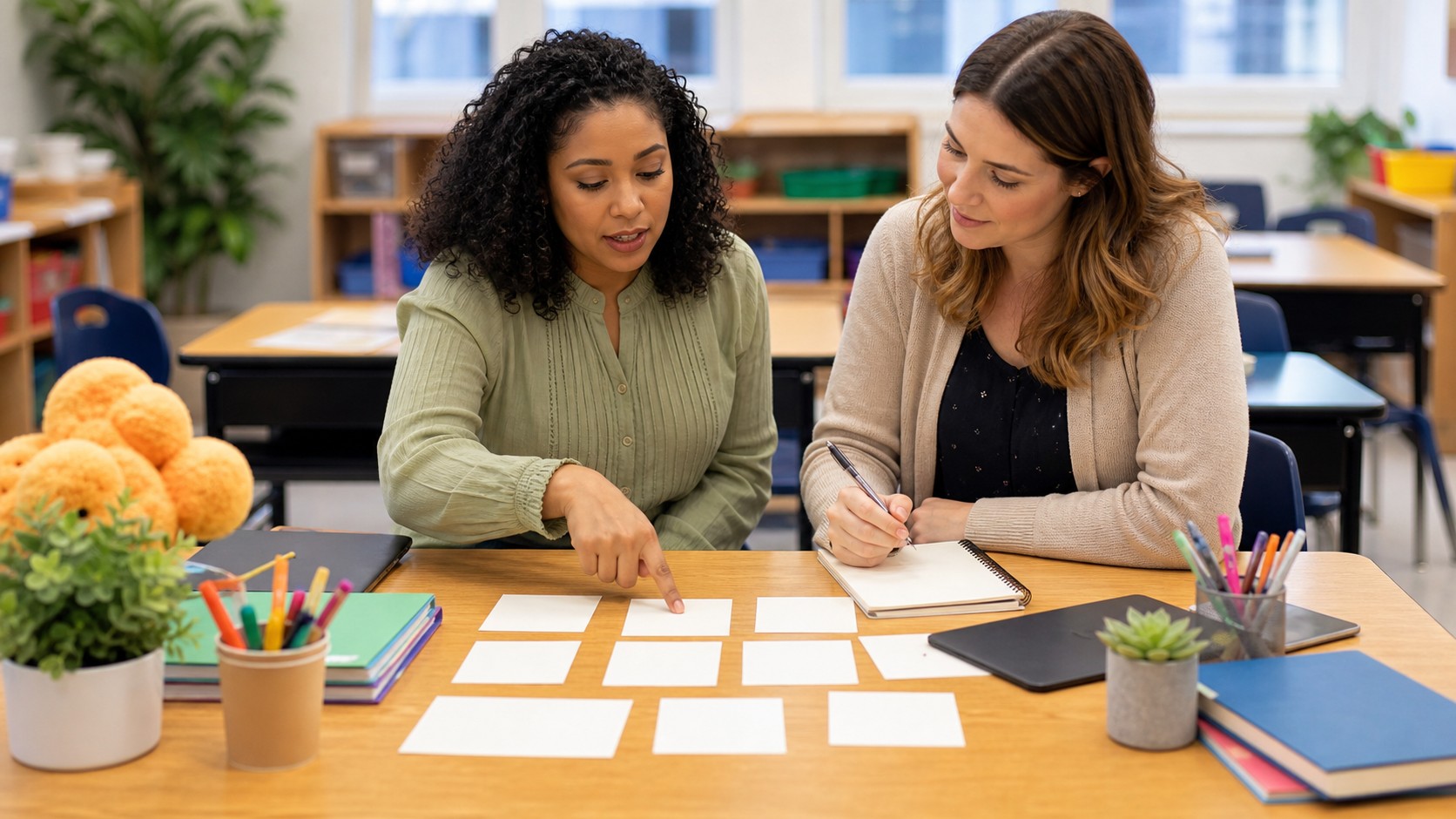
Learning AI as a teacher with no technical background begins with a reassuring truth: the most important first skill is not programming. It is classroom judgment. Teachers already know how to choose materials, adapt explanations, protect learners, notice misunderstanding, and revise plans after a lesson meets real students. AI learning becomes approachable when it is connected to those familiar responsibilities. The goal is to understand what AI can support, what it cannot own, and how to use it without weakening student privacy, integrity, or learning.
A: Yes. Start with classroom tasks, safe prompts, review habits, and privacy rules.
A: Try lesson ideas or public-text summaries, then revise everything yourself.
A: Keep identifiable student information out of unapproved tools.
A: Name the objective, learner level, context, constraints, and format.
A: It can draft options, but teachers must check accuracy, fit, and policy.
A: Give students examples of allowed help, prohibited substitution, and disclosure.
A: Add process evidence such as drafts, conferences, reflection, or explanation.
A: Shared examples reveal classroom issues one teacher may miss.
A: A teacher can run a safe AI workflow and explain its limits.
A: Move toward student AI literacy, assessment redesign, accessibility, or school policy work.
Start With Familiar Teaching Tasks
A teacher does not need to begin with model architecture or machine learning math. A better starting place is the work that already fills the week: planning lessons, creating examples, adjusting reading levels, writing parent messages, developing practice questions, giving feedback, organizing materials, and helping students approach difficult concepts. These familiar tasks make AI easier to understand because the teacher already knows what quality looks like.
Begin by choosing one low-risk task with no student-identifiable information. Ask an approved AI tool for three ways to introduce a topic, then compare the suggestions against your learning objective. Ask for a simpler explanation of a public concept, then check whether the explanation is accurate. Ask for practice questions, then decide which ones actually measure understanding. The teacher remains the professional reviewer.
This approach also prevents overwhelm. AI is a large field, but a teacher's first learning path can be narrow. Instead of trying to understand every tool, begin with one classroom purpose and one safe workflow. Confidence grows when you can see exactly how AI helps or fails inside a task you already understand.
This classroom-first approach also protects teacher confidence. Technical language can make AI feel distant, but teachers can learn by asking whether a tool improves a lesson, saves responsible time, or helps students understand a concept more clearly.
Teachers should also notice how much of AI learning is really question design. The same skill used to diagnose student confusion can be used to diagnose weak AI output: what was missing, what assumption appeared, and what evidence would make the answer stronger?
Build a Plain-Language AI Foundation
Teachers need enough vocabulary to explain AI clearly to themselves, colleagues, students, and families. A model is the trained part of an AI system that responds based on patterns. A prompt is the instruction or question given to the tool. Context is the information the tool can consider. A hallucination is a confident answer that is unsupported or wrong. Evaluation is the process of checking whether the output is useful and accurate.
These terms should stay tied to classroom examples. If an AI tool writes a lesson activity, the prompt is the assignment you gave it. The context may include the grade level, objective, constraints, and source material. The output is a draft, not a finished lesson. Evaluation is the teacher's review for accuracy, fit, accessibility, tone, and policy.
Plain language is important because teachers often become local interpreters of AI. Students may ask what counts as cheating. Parents may worry about privacy. Colleagues may feel pressure to use tools they do not understand. A teacher with clear, calm vocabulary can lower confusion without pretending the technology is simple.
Practice Prompting Like Lesson Planning
Prompting becomes easier when teachers treat it like lesson planning. A strong prompt names the learner level, learning goal, prior knowledge, constraints, desired format, and review need. The more clearly the teacher defines the instructional purpose, the easier it is to judge the result.
For example, a weak prompt asks for "an activity about fractions." A stronger prompt asks for a short, hands-on fraction warm-up for fourth graders who understand halves and quarters but struggle with equivalent fractions, using classroom objects and no technology. That prompt gives the AI a usable teaching frame.
Revision is part of the practice. If the activity is too hard, ask for a version with simpler numbers. If it lacks explanation, ask for teacher notes. If it includes assumptions about student background, remove or adjust them. Each revision teaches both prompt skill and instructional clarity.
A teacher can also practice prompts the way they might practice writing directions for students. If the request is unclear, the result will usually be unclear too. Better instructions reveal better thinking.
Prompt revision can become a low-pressure habit. Teachers can save the first output, name the weakness, revise the prompt, and compare the second output. That comparison is where practical AI learning happens.
Protect Student Privacy From the Beginning
Student privacy should be part of the first AI lesson, not an advanced topic. Teachers should not enter student names, grades, disciplinary details, accommodations, family information, health information, personal stories, or identifiable student work into unapproved AI tools. Even a helpful intention can create risk if the tool is not approved for that data.
Practice with fictional examples, public texts, or teacher-created sample material. If you want to test feedback support, invent a sample paragraph. If you want help rewriting a parent message, use a fictional situation. If you want to adjust a reading passage, use public or approved content. Safe practice builds skill without creating unnecessary exposure.
Privacy also includes what comes out of the tool. An AI-generated comment, summary, or plan may include assumptions that do not belong in a student record or family communication. Teachers should review outputs carefully before sharing or storing them.
Use AI for Planning Without Handing Over Instruction
AI can support planning by generating options. It can suggest examples, discussion questions, warm-ups, vocabulary supports, alternate explanations, or extension activities. These drafts can save time, especially when a teacher is stuck or needs variation.
The teacher still decides what belongs in the classroom. AI may produce activities that sound engaging but miss the objective, introduce misconceptions, ignore classroom realities, or use examples that do not fit students. Planning with AI works best when the teacher begins with a clear goal and edits heavily.
A useful habit is to ask why each activity supports learning. If the answer is vague, the activity may need revision. If the activity cannot be checked against the objective, it should not be used yet. AI should widen the teacher's planning options, not replace pedagogical reasoning.
The privacy habit should become automatic. Before using any AI tool, pause to identify whether the material includes a real student, a family detail, or protected context. That short pause prevents many avoidable mistakes.
Safe planning practice also helps teachers decide where AI is not worth the effort. If a tool produces generic material that takes longer to fix than to write, that is useful information.
Prepare for Student AI Use
Teachers also need to learn AI because students will use it. Some will use it for brainstorming, explanation, translation, editing, or study support. Others may use it to avoid doing the thinking an assignment requires. A teacher without a technical background can still guide this conversation with clarity.
Start by defining acceptable and unacceptable support. A student might be allowed to use AI to generate study questions after reading a chapter, but not to submit an AI-written response as original work. A student might use AI to explain a concept in another way, but still needs to show their own reasoning.
Students benefit from examples. Show what responsible use looks like, what crosses the line, and how to disclose help when required. The goal is not only enforcement. It is teaching students to use powerful tools with honesty and judgment.
Rethink Assessment Gradually
AI can make some traditional take-home assignments easier to outsource. That does not mean every assessment is broken. It means teachers may need to emphasize process, explanation, drafts, in-class checkpoints, oral reflection, source use, and authentic application.
Begin with one assignment. Ask what the assignment is supposed to measure. If AI can complete the product without the student demonstrating that skill, add a process element. Require a planning note, a short conference, a draft comparison, a source explanation, or a reflection about choices made.
Assessment redesign should be gradual. Teachers need time, support, and examples. A single clear change can be more useful than a sudden overhaul that confuses students and families.
Student guidance works best when it is connected to assignments students actually see. Abstract warnings about AI are less useful than showing where help is acceptable and where it replaces learning.
Assessment changes should be explained to students as learning design, not suspicion. When process evidence is required, students should understand how it helps them demonstrate real understanding.
Learn With Colleagues and Policy in Mind
Teachers should not have to learn AI alone. Colleagues can share prompts, failed examples, revised materials, and classroom policies. A small professional learning group can test tools with safe content and discuss what belongs in practice.
Policy matters too. Schools may have rules about approved tools, student data, acceptable use, parent communication, and academic integrity. A teacher should know those rules before using AI with students or student-related material. If guidance is unclear, ask for clarification rather than guessing.
Professional collaboration also improves equity. Teachers in different subjects and grade levels will see different needs. Sharing examples helps schools avoid a situation where only the most confident tool users shape AI practice.
Build a Personal Teacher AI Routine
A sustainable routine can be simple. Once a week, choose a safe teaching task, write a clear prompt, review the output, revise it, and save a short note about what you learned. Rotate among planning, explanation, assessment, communication, and student AI literacy.
Keep a folder of checked examples. Include useful prompts, weak outputs, corrected materials, privacy reminders, and questions for colleagues. Over time, this becomes a teacher-specific AI portfolio. It shows growth without requiring technical credentials.
The routine should leave room for skepticism. If AI does not improve a task, note that. If it creates extra review work, note that too. Learning AI as a teacher means knowing when it helps and when ordinary professional practice is better.
A routine also helps teachers avoid chasing every new platform. The tool may change, but the cycle of safe task, clear prompt, careful review, and reflection remains useful.
That portfolio can also support conversations with school leaders because it shows careful, policy-aware practice rather than casual tool use patterns.
The Teacher Milestone
The milestone is not becoming a technologist. It is being able to design a safe, useful, teacher-reviewed AI workflow for a classroom task. You can explain the purpose, the data boundary, the prompt, the review step, the student impact, and the reason the final choice remains yours.
That milestone is meaningful. A teacher who reaches it can participate in school AI conversations with confidence. They can help students understand responsible use, ask better policy questions, and use AI where it supports learning.
Teachers with no technical background bring exactly what AI needs in education: knowledge of learners, context, care, and judgment. Those strengths should lead the learning path.